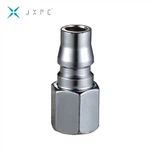
Pneumatic cylinders are usually suitable for factory settings, buildings, factories, buildings and technology by using a central compressed air source as power. Pneumatic cylinders are also common in medical applications, including dentists' high-power drills. In fact, everything can be operated on pneumatic devices, including any form of transportation.
Hydraulic cylinders have many uses in daily life, most of which are suitable for machines. For example, hydraulic pressure is applied to the braking system of an automobile. When the driver presses the car brakes, they only need a small force, but they have generated a greater force to stop or slow down the car, because it also acts on all four brake pads. It is also obvious that hydraulic cylinders are used in lifting equipment, such as digging arms on wheelchair lifts, excavators and other machinery, hydraulic presses for forging metal parts and flaps on aircraft. The obvious use of hydraulic cylinder system is heavy equipment.
Although pneumatic cylinders are less complex in some respects, they usually cannot transfer higher loads and forces. In addition, hydraulic cylinders have the advantage of more stable and controllable movement, because they do not have spring movement related to the release of gaseous fluid medium. The hydraulic cylinder also has the additional advantage that it can perform auxiliary functions such as cooling and lubrication. It can be said that the pneumatic cylinder can achieve higher performance if properly designed without compact floor space, because the availability of power and medium is not negotiable in the design of hydrodynamic system.
The big difference between hydraulic cylinder and pneumatic cylinder is actually the way the cylinder works. Pneumatic cylinders use gas, usually air or pure gas, to transmit power through compressed gas. On the other hand, the hydraulic system of the hydraulic cylinder uses fluids, usually oil, ethylene glycol and other flame retardant liquid options.